

Elite Growth Advisors translates documented nature and place-based observations into credible systems-learning assets—source records, application-system outputs, briefs, workshops, galleries, curriculum, facilitator tools, and licensed collections—that help leaders examine dependencies, risks, responsibilities, and change while preserving clear boundaries between evidence, interpretation, and analogy.
We preserve the integrity of local evidence, identify relevant systems themes, and translate them into carefully bounded questions about resilience, continuity, stewardship, prevention, adaptation, and sustainable growth.

Grand Hall, Union Station, Washington, D.C. — a place-based observation of pathways, thresholds, coordination, and continuity.
From Nature Observation to Responsible Institutional Learning
Institutions increasingly value nature, place, and visual storytelling, but they often lack a disciplined way to convert observations into credible learning assets. Without that discipline, nature-based content can be visually compelling yet disconnected from institutional decisions, inspirational yet unverifiable, or metaphorical in ways that overstate what the evidence supports.
Observation Without Application
Photographs, videos, and field observations are frequently captured but seldom converted into durable, traceable learning resources that institutions can use.
Application Without Evidence Discipline
Nature-based lessons may blur what was directly observed, what was verified, and what is interpretation or analogy, reducing their credibility and usefulness.
Institutional Learning Without Place
Leadership, health, and sustainability programs can remain abstract when they are disconnected from the environments, communities, and places in which people work.
Elite Growth Advisors closes these gaps through a governed Observe–Interpret–Translate method that moves from documented evidence to responsible institutional learning.
A Traceable Path from Observation to Application
We do not simply provide nature imagery or inspirational analogies. We use a governed process that preserves evidence from the observed place, verifies context, identifies the relevant systems theme, and translates it into responsible learning for a clearly defined application system.
Observe and Document
Record what is directly visible or audible, together with the place, date, conditions, source files, metadata, and unresolved uncertainty.
Verify Context
Research and validate the relevant ecological, historical, social, cultural, and institutional context while distinguishing verified facts from assumptions and inference.
Identify the Systems Theme
Select the analytical lens—such as continuity, resilience, stewardship, prevention, access, adaptation, or sustainable growth—that genuinely arises from the observation.
Define the Application System
Name the separate health, institutional, organizational, community, educational, or infrastructure system that the learning activity will examine.
Formulate the Systems Question
Translate the systems theme into a practical question or principle without presenting the natural observation as proof of the institutional conclusion.
Apply and Share Responsibly
Produce briefs, Insight Cards, Field Notes, workshops, galleries, videos, curriculum, or advisory resources with uncertainty and analogy boundaries clearly stated.
Observed System → Systems Theme → Application System
The observed system is the ecological or place-based setting that was documented. The systems theme is the analytical lens that identifies a relevant pattern or question. The application system is the separately defined health, institutional, organizational, community, educational, or infrastructure system being examined.
The systems theme connects the two systems without collapsing the distinction between direct evidence and analogy.
What Was Documented
The ecological or place-based system directly captured through photography, video, audio, metadata, field notes, and other source records.
Example: D&R Canal urban waterway corridor
The Analytical Lens
The recurring systems concept—such as continuity, resilience, stewardship, prevention, access, adaptation, or sustainable growth—used to organize inquiry.
Example: Continuity and stewardship
What Is Being Examined
The separately identified health, institutional, organizational, community, educational, or infrastructure system to which the learning question is applied.
Example: Hospital patient pathway
The observed system provides evidence about the documented place. The systems theme supports inquiry. The application system requires its own relevant domain evidence.
Observation is not proof. Analogy is not evidence. Context matters.
Local Observation • Global Learning
Bridging Borders enables institutions to learn across places without stripping observations from their local context. Elite Growth Advisors preserves the evidence from the observed place, verifies the relevant ecological, social, cultural, and institutional conditions, and translates shared systems themes into carefully bounded questions for use across countries and sectors.
Questions and systems themes may travel across borders. Unsupported conclusions do not.
Document Locally
Preserve the observed place, direct evidence, source records, metadata, rights, and unresolved uncertainty.
Interpret in Context
Verify the relevant ecological, historical, social, cultural, and institutional conditions before developing broader learning.
Learn Across Borders
Transfer systems themes and carefully framed questions across settings—not unsupported conclusions or claims detached from local evidence.
A canal corridor documented in New Jersey, USA does not prove how a hospital in Uganda, a university in Europe, or a community organization elsewhere should operate. It can, however, provide a disciplined visual lens for examining continuity, maintenance, access, and stewardship within each separately defined context.
Local evidence remains local. Systems questions may be adapted responsibly across borders.
The result is not simply greater appreciation of nature. Stakeholders gain a more disciplined way to see systems, frame questions, communicate insight, create reusable learning assets, and support responsible institutional action.
Clearer Systems Questions
Make relationships, dependencies, interfaces, constraints, risks, and stewardship responsibilities easier to identify and discuss.
Reusable Knowledge Assets
Convert observations into approved Insight Cards, Field Notes, briefs, slides, galleries, videos, curriculum, and other resources that can support repeated institutional use.
Stronger Institutional Dialogue
Create visually grounded discussion materials for leadership teams, staff, students, communities, boards, sponsors, and cross-sector partners.
Place-Based Relevance
Ground learning in actual environments, campuses, waterways, parks, communities, and institutional landscapes rather than relying only on generic case material.
Responsible Cross-Context Learning
Adapt systems themes and questions across countries, sectors, and organizations while preserving local evidence, contextual differences, uncertainty, and analogy boundaries.
Choose the Right Engagement Pathway
Elite Growth Advisors offers advisory, place-based, learning, sponsorship, and licensing pathways that can be tailored to an institution’s question, audience, location, timeline, and intended application.
Strengthen Institutional Learning and Decision-Making
Institutional Consulting and Facilitated Learning
Customized systems-learning engagements for hospitals, universities, foundations, corporations, public agencies, and leadership teams.
Training and Professional Development
Workshops, courses, field-learning experiences, professional cohorts, educator development, and facilitator preparation.
Turn Places into Learning and Engagement Assets
Commissioned Place-Based Projects
Photography, video, source records, verified interpretation, briefs, galleries, workshops, and stakeholder discussion resources focused on a defined place.
Sponsored Learning Series
Sponsor-supported Insight Cards, Field Notes, videos, galleries, workshops, and public-learning initiatives delivered with editorial and evidence safeguards.
Extend the Reach of Approved Learning Resources
Institutional Content Licensing
Controlled institutional use of approved cards, photographs, slides, briefs, videos, facilitator guides, curriculum, and curated learning collections.
Available Asset Types
Insight Cards • Field Notes • Living Systems Briefs • Presentation slides • Photographs • Videos • Galleries • Facilitator materials • Curriculum modules
The Canal Through the City
A documented section of the D&R Canal in Trenton, New Jersey, provides a practical example of how direct observation, verified context, a systems theme, and a separately defined application system can be connected without treating analogy as evidence.
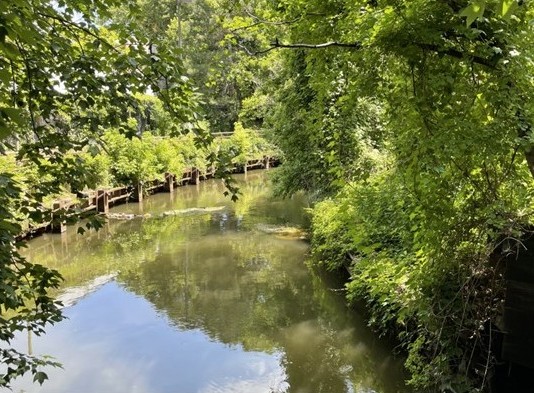
D&R Canal urban waterway corridor in Trenton, New Jersey
Water, dense vegetation, reflected sky, retaining structures, towpath access, surrounding urban features, and audible bird activity were documented.
Continuity, stewardship, access, maintenance, and interdependence
Hospital patient pathway and continuity-of-care processes
Which relationships, hand-offs, safeguards, and maintenance responsibilities must remain connected for continuity of care?
The canal provides a visual framework for examining continuity, access, maintenance, and stewardship. It does not prove how healthcare should be organized or establish a clinical outcome.
Possible outputs: Insight Card • Bridging Borders Field Note • Living Systems Brief • Leadership Workshop • Digital Gallery Entry
Designed for Institutions, Communities, and Learning Partners
The practice can be adapted to different institutional questions, audiences, places, and learning objectives while maintaining the same evidence, context, and analogy safeguards.
Health and Care Institutions
Use place-based systems learning to examine continuity, prevention, access, workforce development, patient pathways, stewardship, and organizational resilience.
Universities and Educational Programs
Integrate documented observations, systems questions, field learning, interdisciplinary discussion, curriculum resources, and professional development.
Foundations and Philanthropic Partners
Support credible learning initiatives, sponsored content, community engagement, and place-based projects with clear editorial and evidence safeguards.
Corporations and Leadership Teams
Strengthen leadership development, sustainability learning, systems thinking, employee engagement, and responsible organizational reflection.
Public Agencies and Community Organizations
Develop locally grounded resources that support stewardship, public learning, environmental awareness, community dialogue, and cross-sector collaboration.
Museums, Publishers, and Cultural Platforms
License or commission approved photographs, videos, briefs, exhibitions, interpretive materials, and curated learning collections.
Learning Resources Designed for Repeated Use
Documented observations can be developed into approved knowledge assets for leadership development, teaching, professional learning, public engagement, institutional reflection, and cross-context dialogue.
Each format preserves source integrity, verified context, uncertainty, attribution, rights, and the boundary between direct evidence and analogy.
Insight Cards
Concise visual learning assets that combine a documented observation, verified context, a clearly identified systems theme, a bounded application question, and an explicit evidence-and-analogy safeguard.
Bridging Borders Field Notes
Place-based records that preserve local evidence and context while translating relevant systems themes into carefully framed questions for use across countries, sectors, and institutions.
Living Systems Briefs
More detailed analytical resources that connect documented observations, verified context, systems relationships, stakeholder implications, and bounded opportunities for institutional learning
Workshops and Facilitated Learning
Structured sessions that use photographs, field records, systems questions, and guided discussion to help teams examine continuity, stewardship, resilience, prevention, adaptation, and sustainable growth.
Digital Galleries and Exhibitions
Curated collections of approved photographs, captions, contextual notes, systems themes, and learning prompts designed for websites, campuses, museums, conferences, and public engagement.
Video Learning Resources
Short-form and extended video resources combining documented environments, narration, verified interpretation, systems questions, attribution, and clearly stated evidence boundaries.
A Clear Path from Initial Question to Approved Learning Asset
Each engagement begins with a clearly defined institutional question, audience, place, and intended use. Elite Growth Advisors then establishes the evidence requirements, develops the appropriate learning approach, and prepares outputs for review and responsible use.
Scope, evidence, interpretation, rights, review authority, and analogy boundaries are agreed before publication or institutional deployment.
Define the Engagement
Clarify the institutional question, intended audience, relevant place, desired use, project scope, rights, and review authority.
Document and Verify
Gather the direct observations, source files, metadata, field notes, and contextual research needed to distinguish verified evidence, interpretation, uncertainty, and inference.
Develop the Learning Asset
Identify the appropriate systems theme, formulate the bounded learning question, and produce the agreed brief, card, workshop, gallery, video, curriculum, or advisory resource.
Review and Deploy
Review evidence, attribution, rights, contextual accuracy, uncertainty, and analogy boundaries before approval, publication, licensing, or institutional use.
Evidence, Context, and Responsible Translation
Every project is designed to preserve the integrity of the documented observation while making its institutional use transparent, proportionate, and reviewable. Evidence, interpretation, uncertainty, analogy, rights, and approval status remain distinguishable throughout the process.
A compelling learning resource must remain traceable to its sources, honest about uncertainty, and clear about what the observation does—and does not—support.
Source Traceability
Observations and factual claims remain connected to source photographs, recordings, metadata, field notes, dates, locations, citations, and other supporting records.
Context Verification
Relevant ecological, historical, social, cultural, and institutional context is checked against credible sources before it is used in interpretation or learning materials.
Uncertainty Disclosure
Unknowns, limitations, tentative identifications, assumptions, unresolved questions, and interpretive inferences are identified rather than presented as verified facts.
Rights and Attribution
Ownership, permissions, licensing conditions, releases, source credits, and attribution requirements are established before publication, sharing, or institutional use.
Analogy Boundaries
Direct evidence from the observed system remains distinct from the systems theme and the separately examined application system. Analogy is never presented as proof.
Review and Approval
Draft, review, and approved status remain visible, and the designated review authority confirms evidence, wording, rights, safeguards, and intended use before deployment.
Understanding the Practice and Its Boundaries
These answers clarify how Elite Growth Advisors uses documented observations, systems themes, institutional applications, and cross-context learning responsibly.
Is this environmental consulting?
Not necessarily. Nature as Systems Intelligence is a systems-learning and advisory practice that uses documented observations of nature and place to support responsible institutional inquiry. It does not replace ecological, engineering, clinical, legal, or other specialist advice when those disciplines are required.
How is direct evidence kept separate from analogy?
Direct evidence describes what was documented and verified in the observed place. The systems theme provides an analytical lens. The application system is examined separately and requires its own relevant evidence. The natural observation is not presented as proof of an institutional conclusion.
Can learning from one place be used in another country?
Yes, but only with appropriate boundaries. Systems themes, questions, and learning methods may be adapted across countries and sectors. Local conclusions, factual claims, and contextual assumptions are not transferred without independent verification.
What source material can support a project?
Source material may include photographs, video, audio, metadata, field notes, maps, public records, archival sources, stakeholder interviews, institutional records, and other approved documentation. The exact evidence package depends on the project scope and intended use.
What types of outputs can be produced?
Outputs may include Insight Cards, Bridging Borders Field Notes, Living Systems Briefs, advisory reports, workshops, digital galleries, videos, presentation materials, curriculum modules, facilitator guides, and licensed institutional content.
How does an engagement begin?
The process begins by defining the institutional question, intended audience, relevant place, desired output, timeline, rights, review authority, and intended use. Elite Growth Advisors then recommends an appropriate evidence, learning, and production pathway.
Explore a Project, Partnership, or Learning Engagement
Share the institutional question, place, audience, or learning objective you would like to explore. Elite Growth Advisors will help determine an appropriate advisory, place-based, sponsorship, training, or knowledge-asset pathway.
Initial conversations are exploratory and do not commit either party to a project, publication, or partnership.
Begin with a Focused Inquiry
In your message, identify the institutional question or opportunity, the relevant place or audience, the type of support being considered, and any known timeline or intended use.